Moving from Agentic to Autonomous SOC in Machine-Speed Cyber Defense
Welcome Stanford Applied Cyber group! Broadcasting live from the DeepTempo office space in Austin, Texas at Station Austin, bringing real-world operational lessons from high-stakes telemetry, flightlines, fabs, and data centers into modern AI security operations.

Implementation Engineer @ DeepTempo
Community Lead for VigilSOC β’ Open-Source AI SOC
High-Level Pathway: From Operational Foundations to Autonomic AI & Open Q&A
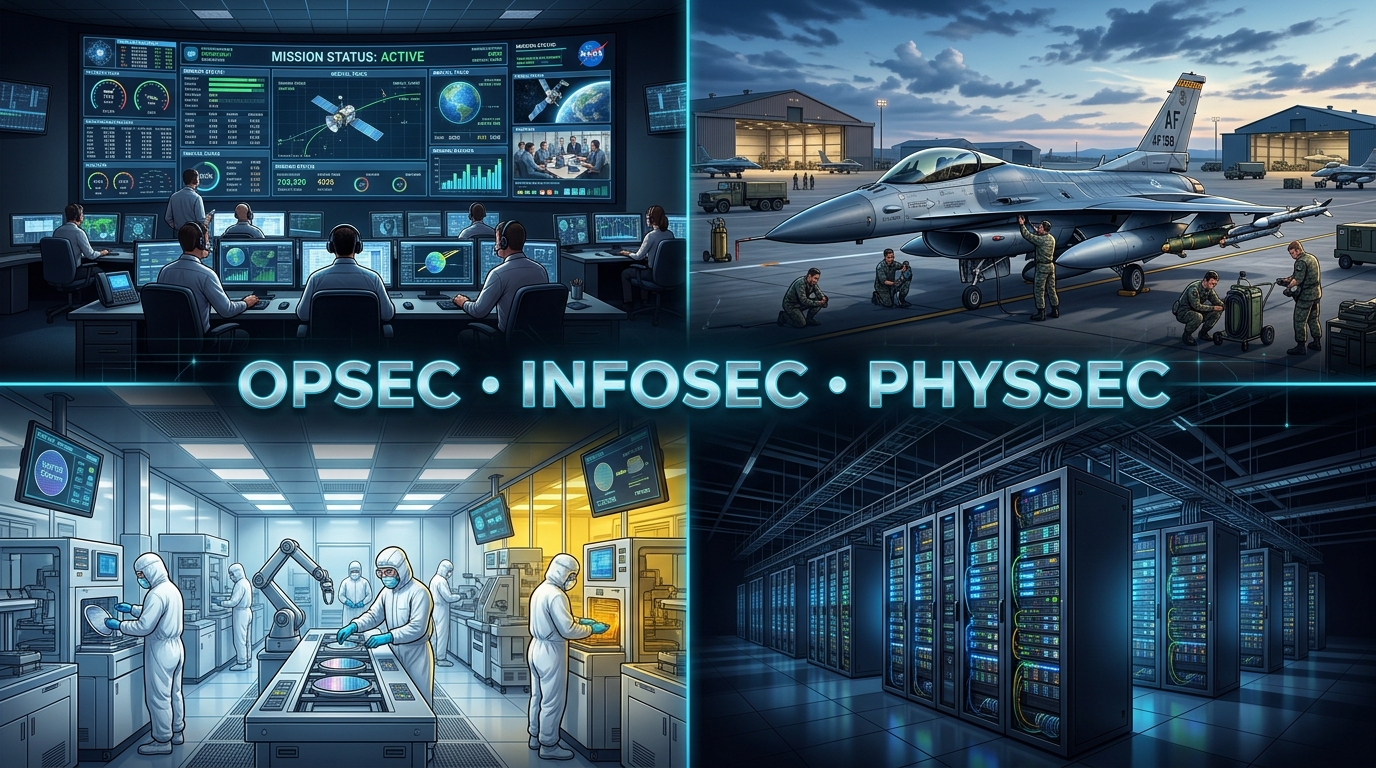
High-Reliability & Mission-Critical Infrastructure Engineering
Early career at Johnson Space Center Mission Control Center. Total Operational Awareness and Zero-fault Tolerance.
F-16 Tactical Fighter Crew Chief post-9/11. Flightline operational readiness, combat sortie safety, relentless checklist discipline.
Cleanroom microelectronics & wafer fabrication infrastructure. Nanometer precision, physical asset control, high-yield fab ops.
HostGator, Codero, Patmos. Bare-metal & virtual machine scaling from single racks to 15MW data center facilities.
Operational Security (OpSec) β’ Information Security (InfoSec) β’ Physical Security (PhysSec)
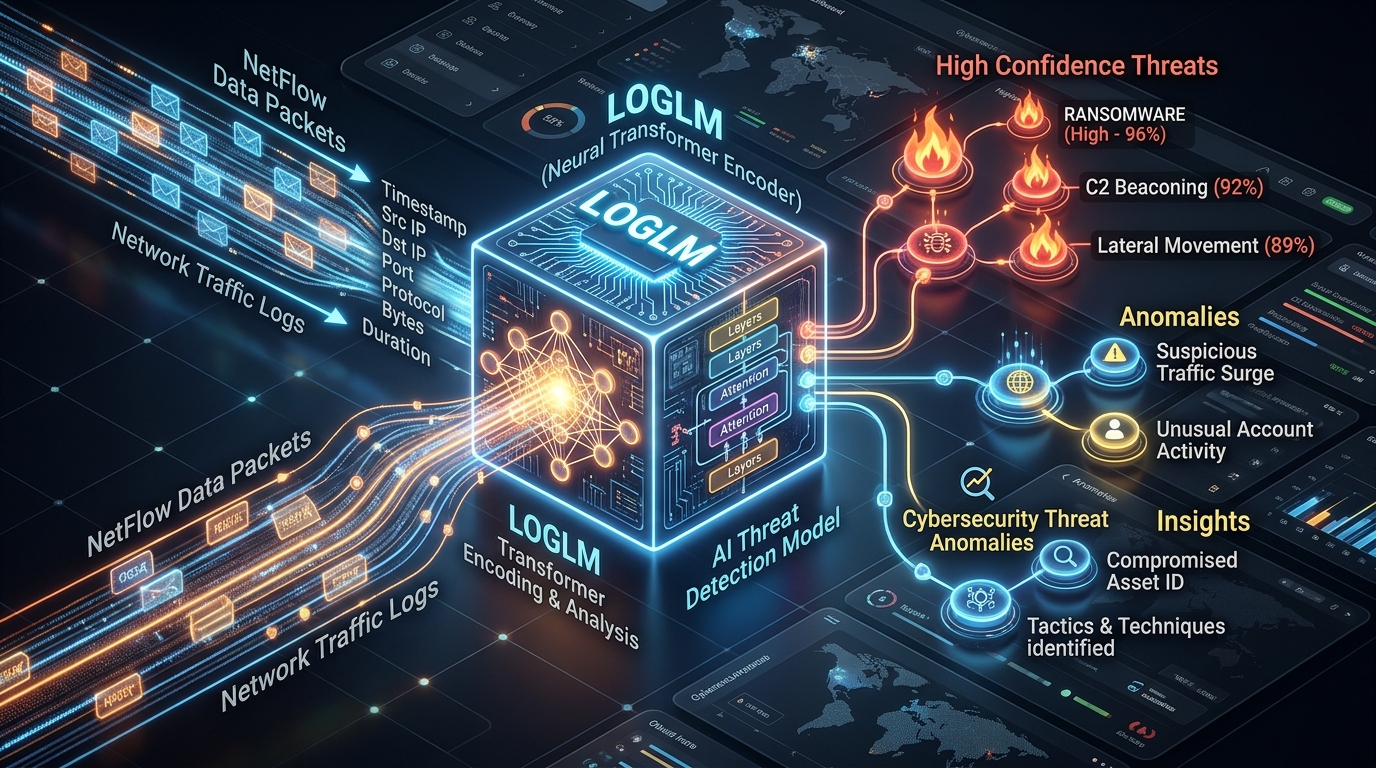
Transformer-Based Encoders for Security Telemetry & Anomaly Surfacing
The Open-Source AI SOC Platform (Apache 2.0 License)
The Open Source AI Security Operations Center
Revealed as the internal solution to harness LogLM for organizations and security teams that lacked a modern ingest pipeline.
Autonomous agents dedicated to triage, artifact extraction, PCAP correlation, threat hunting, and report generation.
Built on the Model Context Protocol (MCP) to plug seamlessly into existing security tools, SIEMs, and cloud APIs.
Playbooks written in plain-text, agent logic in readable Python, and full freedom to plug in any local (Ollama) or remote LLM.
Directly ingests, normalizes, and compiles open-source community detection rules pulled from public repositoriesβsupporting Sigma, Splunk (SPL), Elastic (EQL), and Microsoft KQL rule syntax natively into agent hunting DAGs.
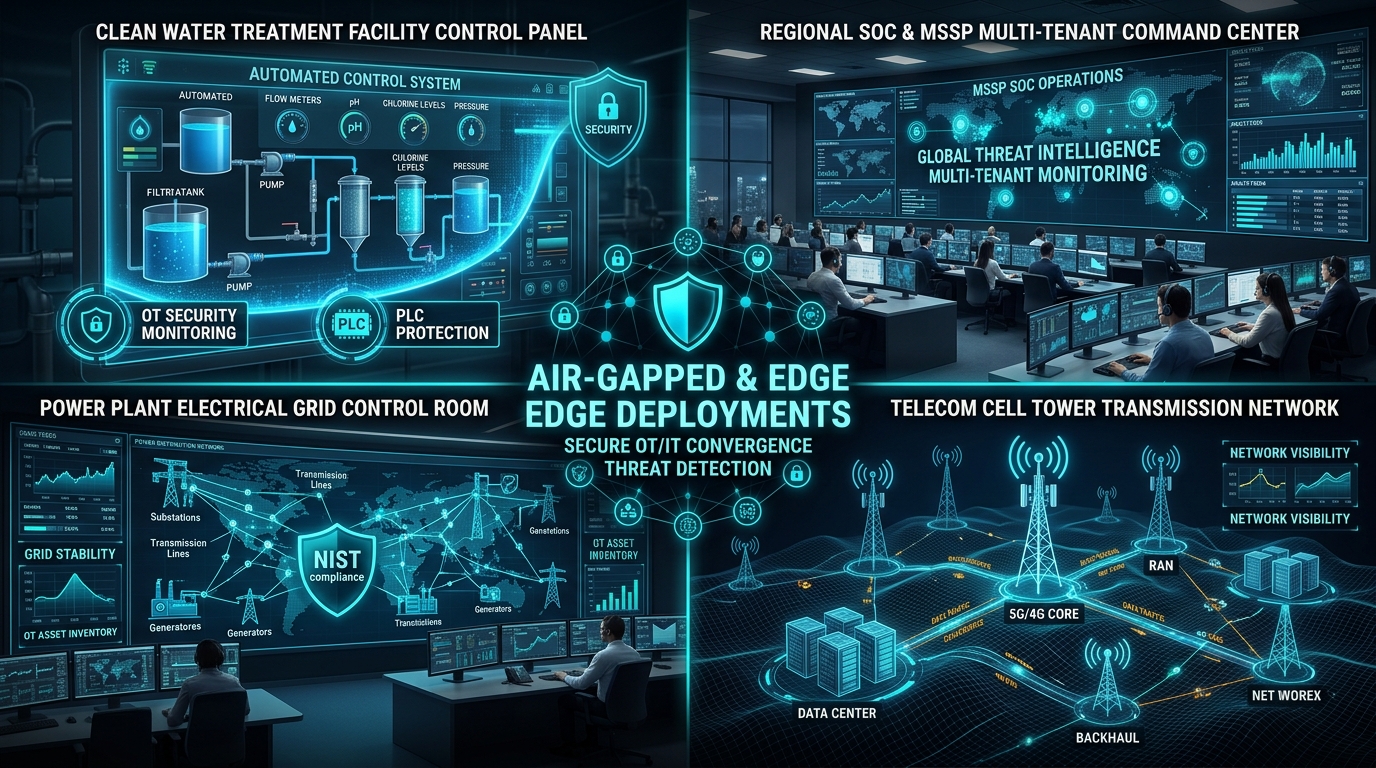
Large Air-Gapped Installs & Edge Cyber Protection
Deployed in isolated, air-gapped environments for major telco providers, safeguarding 5G backhaul, core transmission nodes, and fiber routing without cloud dependencies.
Real-time autonomous threat detection deployed directly at the edge across essential industrial control (SCADA/HMI) and multi-tenant security operations:
From Blue Defenders to Purple Automation & The Emerging White Team Operator Paradigm
Primary user base: SOC analysts, threat hunters, and MSSP operators using VigilSOC for automated telemetry ingest, LogLM zero-shot triage, and machine-speed mitigation.
Community-contributed modules: Automated adversary simulation playbooks, synthetic attack generation, and continuous attack-surface probing to stress-test detection boundaries.
Continuous collaborative loop: Real-time feedback engine matching offensive Red simulation against Blue detection DAGs to validate and self-correct playbooks automatically.
A DAG (Directed Acyclic Graph) is a mathematical graph of directed nodes and non-circular edges. In VigilSOC, DAG harnesses replace 2,000-word prompt bloat with deterministic agent routing, conditional decision branches, and strict circuit-breaker kill switches.
Laying the Foundations of the Agentic SOC Engine (Mar 2026 β May 2026)
Personal Perspective (May 2026 Presentation: "Agentic SOC Operations: OSS AI Tooling"): Frame VigilSOC fundamentally as a Blue Team Defender Tool operating with an explicit, unyielding assumption of Human-IN-the-Loop (HITL) validation at every execution step before taking action.
Expanding Swarm Collaboration & Enterprise MCP Integrations (Jun 2026 β Sep 2026)
Personal Perspective (June 2026 Presentation: "The Agentic Battlefield: Red vs Blue Agents"): Noted heavy community adoption of red team tooling while shifting to Human-ON-the-Loop (HOTL) supervisory principles as humans still couldn't keep up with triage.
Re-Imagining Autonomy in Modern Cyber Operations (Target: Q4 2026)
Moving from Agentic SOC (AI assisting human operators with isolated tools) to Autonomic SOC (self-coordinating, machine-speed defense swarms).
Blue teams stop acting as manual alert triagers and start acting as Supervisors managing large fleets of autonomous AI agents operating at machine speed.

Personal Perspective (Hacker Summer Camp Takeaways): Focus shifted to full autonomy with strict guardrails, confidence scores, and automatic remediation while incorporating continuous feedback loops for False Positives (FP) and False Negatives (FN).
By Mayank Kumar (Founding AI Engineer, DeepTempo) β’ Non-Linear Threat Hunting
At inference, model weights are fixed. Tokens condition the forward pass to select which learned behavior responds. The real artifact is the dynamic Selection Function, not a 2,000-word prompt.
Threat hunting (PEAK & TaHiTi frameworks) requires iterative pivotsβfrom Netflow to process telemetry, credentials, and cloud audit logs. Knowing when to kill a dead-end hunt branch early is critical.
Linear pipelines hide looping; adding "always/never" prompt rules leads to 2,000-word prompt bloat and infinite agent loops. Vigil 0.5.0 replaces static prompts with dynamic iteration constraints.
Built with StackStorm complex automation heritage. Decides every iteration what the agent sees and what tools it may execute, encoding expert human threat hunter intuition directly into code controls.
Concrete Code Evolution in Vigil-SOC/vigil β What Was Removed vs. What Replaced It
By Sam Armstrong β’ Building Vigil via Autonomous Engineering Factories
Autonomous agents groom the backlog, author PRs against Vigil, review code changes, and self-repair build environments when test harnesses stall.
Clean diffs don't guarantee runtime correctness. The factory executes live validationβrunning changes and exercising agent tool bindings before merging.
Small teams cannot manually review high-volume community contributions. The factory drives product direction while scaling open source contribution velocity.
When build harnesses stall, agents diagnose environmental failures, resolve broken dependencies, and repair test environments autonomously without human intervention.
Quantifying Velocity in Vigil-SOC/vigil β Commits, Overlapped PRs & High-Cadence Code Quality
Continuous overlapping PR streams groomed, authored, and verified in parallel without human code-review bottlenecks.
Exponential commit volume trajectory from 120 (Mar) to 520+ monthly commits (Sep 2026) across 1,840+ total commits.
Enforced Python type hints, 94%+ automated unit test coverage, and deep runtime tool-action verification before merging.
CI test harnesses that detect stalled builds, diagnose broken test dependencies, and self-repair environments autonomously.
Bridging Governance Specifications, Code Execution & Internal Cursor Factory Sync
Version-controlled governance documents defining non-negotiable boundaries, intent, and schema contracts:
principles.md: Local-first privacy, zero black-box wrappers, open-source Apache 2.0.intent.md: Declarative agent goals, hunt boundaries, and threat hunter intuition in code.versioning.md: Strict semantic release criteria and API contract stability guarantees.
Concrete runtime execution engine implemented directly in Vigil-SOC/vigil:
Autonomous factory generating code upstream & syncing to the public repo:
Vigil-SOC/vigil.Mitigating Supply Chain Attacks, Sockpuppet Networks & Malicious Contributions
Threat actors use coordinated sockpuppet accounts to pressurize fatigued maintainers into transferring repo permissions or approving malicious PRs (e.g., 2-year XZ Utils long-con).
Automates initial code triage and removes human emotional social-engineering vectors; PRs are verified by objective automated factory agents rather than pressure.
Steganographic binary payloads in test archives, multi-stage build-script hooks (m4 macros), or hidden zero-day backdoors targeting downstream production binaries.
Deep isolated runtime sandbox execution. Diffs are never accepted on visual inspection alone; the factory executes full runtime behavior analysis before merging.
High-volume automated AI "slop" PRs, typosquatted dependency additions, or subtle logic vulnerabilities designed to slip past human code reviews.
Enforces AST typing, dependency provenance validation, automated static analysis, and 94%+ test coverage gates to discard low-quality or poisoned contributions.
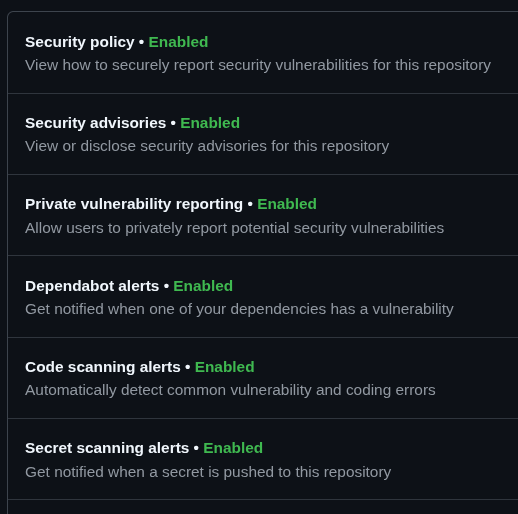
Repository Hardening, Automated Scanners & Vulnerability Reporting Controls
github.com/Vigil-SOC/vigil)
SECURITY.md)
β Enabled
Standardizing Vulnerability Reporting via RFC 9116
Adopting the IETF standard for /.well-known/security.txt to provide security researchers with clear, machine-readable contact information, encryption keys, and disclosure policies.
Establishing private vulnerability triage channels, fast patch SLA commitments, and transparent PGP-signed security advisories for open-source AI SOC infrastructure.
Submitting a private vulnerability automatically provisions a temporary private repository fork. Maintainers and the reporter collaborate directly in secret to author, test, and verify patches through to coordinated public release & CVE issuance.
# Vigil SOC β security.txt # Standard: RFC 9116 (https://www.rfc-editor.org/rfc/rfc9116) # Canonical location: https://vigilsoc.org/.well-known/security.txt # # To report a vulnerability, please use GitHub private vulnerability reporting # (preferred) or the security email below. Do NOT open public GitHub issues. Contact: https://github.com/Vigil-SOC/vigil/security/advisories/new Contact: mailto:[email protected] Preferred-Languages: en Policy: https://vigilsoc.org/security Canonical: https://vigilsoc.org/.well-known/security.txt
Supply Chain Provenance, Integration Path Penetration, Inference Red-Teaming & MCP Spec Hardening
Task: Publishing a comprehensive, cryptographically signed Software Bill of Materials (SBOM) with standardized in-repo manifests (CycloneDX / SPDX).
Impact: Provides enterprise consumers with verifiable build attestations, provenance tracking, and automated transitive dependency validation.
Task: Penetration testing and threat modeling targeting internal event-driven DAG execution hooks, multi-agent IPC channels, and external API connectors.
Impact: Prevents malicious webhooks or manipulated payload data from hijacking DAG execution flow or breaching sandbox isolation.
Task: Adversarial red teaming directed at the configured Inference & Model providers (local foundation models, self-hosted LLMs, or cloud API endpoints), evaluating prompt-injection resilience, token manipulation, and model provider integrity.
Impact: Ensures adversarial telemetry or manipulated inputs cannot blind inference encoders, bypass safety guardrails, or trick downstream triage swarms regardless of the underlying model provider.
Task: Active review and refactoring of 30+ Model Context Protocol (MCP) connectors for compliance with latest MCP spec updates.
Impact: Enforces standardized state persistence rules and fine-grained authentication/authorization primitives across all external tool integrations.
Frequently Surfaced Agentic Challenges and Concerns
Should we establish Agentic ToS like we have Human ToS?
As non-human AI agents interact autonomously across APIs, execute security actions, and consume cloud services, how do legal and operational terms of service adapt to agentic entities?
Is ISO 42001 the best starting point for AI management, or are emerging threat & compliance frameworks taking precedence?
Evaluating the convergence of ISO/IEC 42001 (AIMS) and NIST AI RMF alongside trending operational standards: OWASP Top 10 for LLMs, EU AI Act compliance mandates, MITRE ATLASβ’ threat modeling, and CSA STAR for AI to govern autonomous agent fleets in enterprise production.
How do we cryptographically verify multi-agent delegation & prevent cascade poisoning?
When autonomous agents delegate tools to downstream sub-agents over zero-trust boundaries, how do we guarantee cryptographic identity, prevent prompt injection hijacking, and enforce circuit breakers before machine-speed mitigation causes self-inflicted blackout?
Comparative Spectrum: ISO 42001, NIST AI RMF, OWASP, EU AI Act, MITRE ATLAS & CSA STAR
Domain: Management Systems.
Focus: Org-wide policy, continuous improvement, & ethical AI governance controls across life cycles.
Domain: Risk Management.
Focus: 4 Core Functions (Govern, Map, Measure, Manage) for trustworthy, bias-aware AI operations.
Domain: Application Security.
Focus: Tactical vulnerabilities (Prompt Injection, Data Poisoning, Insecure Output, Supply Chain).
Domain: Legal Compliance.
Focus: Risk classification (Unacceptable, High, GPAI), requiring conformity assessments & audits.
Domain: Adversary Tactics.
Focus: Threat matrix mapping real-world ML attacks (Model Evasion, Weight Theft, Poisoning).
Domain: Cloud AI Services.
Focus: Security assurance, data privacy guarantees, and tenant isolation for cloud AI deployments.
Bay Area Industry Meetups, Free Virtual Webinars & Community Workshops
Connecting AI & cybersecurity leaders across academia and industry. Live Bay Area events hosted at #SVAI in Menlo Park:
Free practitioner-led virtual webinars, interactive workshops, and education on AI security governance & defense:
Join open community office hours with VigilSOC maintainers & threat researchers. Discuss agent DAG workflows, custom MCP tool connectors, playbooks, and real-world deployment telemetry.
Join the Open AI SOC Revolution β’ Connecting with DeepTempo, VigilSOC & AI Cyber Alliance
Email John Van Lowe directly for platform research, enterprise deployments, or community collaboration:
Connect with John Van Lowe on LinkedIn to follow ongoing research and platform updates:
Core open-source projects, community channels, and benchmarks:
Explore prior keynotes, whitepapers, and slide archives: